Burmese Scripts
A syllable combines consonants, vowels, medial consonants, final consonants, and tone marks.
Okell's Burmese by Ear (2009, pp. 136–142):
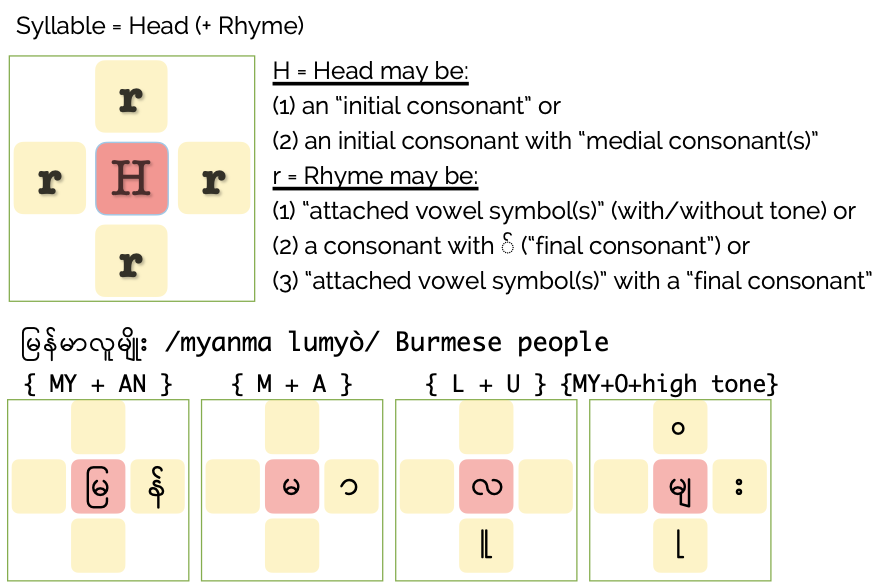
က /ká/ — Head consonant က — to dance
ကာ /ka/ — Head consonant က + rhyme vowel ာ — to cover
ကား /kà/ — Head consonant က + rhyme vowel ာ + tone း — car
You do not need to memorize everything at once. Start with the basic consonants and how they combine with vowels.
Find John Okell's Burmese by Ear in Resources.
Find BAMA Basic Scripts Cheatsheet and How to Write Burmese Scripts in Downloads.
Listen
Audio by Ko Nay Htet Aung.
Romanization
Romanization helps you pronounce new vocabulary, but listening to and imitating local pronunciation is more important than memorizing romanized spellings. Unlike Chinese Pinyin, Burmese does not have one officially standardized system of romanization. Here we use the system developed by John Okell.
Head
Aspirated vs. unaspirated: ကျက် /ceq/ vs. ချက် /c’eq/
Breathed vs. non-breathed: မာ /ma/ vs. မှာ /hma/
hm- represents a breathed m. Try saying it with a small amount of air before the m, similar to the sound in “humph.”
Rhyme
Nasal vs. Glottal stop: ကန် /kan/ vs. ကပ် /kaq/
Find BAMA Basic Scripts Cheatsheet with Okell's Romanization in Downloads.
Tones
A similar sound with a different tone can have a completely different meaning. When learning new vocabulary, always pay attention to how a local speaker actually pronounces it.
စ /sá/ — to start
စာ /sa/ — text, lesson, writing
စား /sà/ — to eat
တစ်ထောင် /tă-t’aun/ — 1,000
တစ်သောင်း /tă-thaùn/ — 10,000
Main Tones
Burmese has three main tones. In addition, John Okell's system identifies a glottal stop and a weak syllable as important pronunciation features.
အာ့ á — creaky high tone
အာ a — low tone
အား à — plain high tone
အတ် aq — glottal stop
အ ă — weak syllable
Listen
Audio by Ko Nay Htet Aung.
Word Order
Conversation in Burmese often follows object-verb order, and the subject may be left out.
For example:
/t’ămìn sà meh/
Literally: rice-eat-future suffix
Depending on the context, this can mean “Let's eat”, “I am going to eat”, or “You/he/she is going to eat”.
John Okell describes a typical Burmese sentence as consisting of one or more noun phrases [NP] followed by a verb phrase [VP]. Here, “noun phrase” is used broadly to include adverbs and other elements.
ကျွန်မ အမျိုးသား [NP1] ဗမာစကား [NP2] နဲနဲ [NP3] နားလည်ပါတယ် [VP]။
Literally: my husband-Burmese language-a little-understand-suffix1-suffix2
“My husband understands a little Burmese.”
Pay attention to the type of suffix used. A suffix can be attached to a sentence, phrase, verb, noun, or can subordinate one sentence to another.
Okell also notes, words such as ပူတယ် /pu-deh/ and အေးတယ် /è-deh/ are translated into English as adjectives such as “hot” and “cold”, but grammatically they are verbs: “to be hot” and “to be cold”.
Aspect in Burmese
Compared with English, Burmese is often described in terms of aspect rather than tense.
Romeo 2008: 1:
“Aspect is the verbal category that most typically describes the ways “... of viewing the internal temporal constituency of a situation” (Comrie 1976: 3).
Aspect differs considerably from tense, “... which relates the time of the situation referred to to some other time, usually to the moment of speaking” (Comrie 1976: 1-2).
In other words, aspect indicates the temporal structure of an event, while tense indicates the temporal location of an event (Bhat 1999:43).”
Romeo 2008: 67-68:
1) the reality of the event, i.e. its past or present existence in the real world of events in esse, as well as
2) the declarative quality of the utterance that describes the event itself.”
မိုးရွာနေတယ် /mò-ywa ne deh/ (It is/was raining.) [Okell and Allott 2001: 94]
သွားပါအုံမယ် /thwà ba oun meh/ (“I’ll be going.”) [Okell and Allott 2001: 161]
For learners comparing Burmese with English, three important suffixes are useful to recognize:
-
REALIS ~ present & past
-တယ် /-teh/
စားတယ် /sà-deh/ — eat or ate
-
IRREALIS ~ future
-မယ် /-meh/
စားမယ် /sà-meh/ — going to eat
-
Finished / completed
-ပြီ /-pi/
စားပြီးပြီ /sà-pi-bi/ — finished eating
Voicing
The voicing rule (Okell's term) is blocked when the syllable ends with a glottal stop (-q).
Voicing rule applied
စား တယ် (sa + teh)
တယ် is voiced to
ဒယ်, so it is pronounced
/sa-deh/.
Voicing rule blocked
စပ် တယ် (saq + teh)
Because the preceding syllable ends in a glottal stop,
တယ် is not voiced to
ဒယ်.
We pronounce it /saq-teh/.
| These | k- | c- | t- | s- | p- | th- |
|---|---|---|---|---|---|---|
| And these | k'- | c'- | t'- | s'- | p'- | |
| Voiced to | g- | j- | d- | z- | b- | dh- |
More examples:
- မှာ တယ် (hma + teh): teh voiced to deh → /hma-deh/.
- သောက် တယ် (thauq + teh): teh is NOT voiced to deh → /thauq-teh/.
- ပြောတတ်တယ် (pyàw + taq + teh): taq voiced to daq, teh is NOT voiced to deh → pyàw-daq-teh.
Weakening
When a syllable is weakened (Okell's term), its rhyme is replaced by the vowel -ă.
End with -q:
- တစ်ဆယ် tiq + s'eh → /tăs'eh/
- နှစ်ရာ hniq + ya → /hnă-ya/
Combination with a particle:
- စပ်သလား။ saq-teh + là → /saq-thălà/
- ဘာစားမလဲ။ ba + sa-meh + lèh → /ba sa-mălèh/
Unpredictably:
- ငါးကင် ngà + gin → /ngăgin/
Suffixes
Okell BBE 2009: 146-161:
“A suffix is an element that is attached to the end of a word, like the English -ing in words like learning, thinking, etc. Most of the grammatical information in a Burmese sentence is carried by suffixes. Most suffixes are used with just one part of speech.”
Suffixes can be attached to sentences, phrases, verbs, nouns, and as subordinates one sentence to another.
Changes on suffix change the meaning.
စာအုပ်ပေး။ /sa-ouq pè/ — Give me the book!
စာအုပ်ပေးပါ။ /sa-ouq pè ba/ — Please give me the book.
ကျွန်တော်ကစာအုပ်ပေးတယ်။ /cănaw-gá sa-ouq deh/ — I [as the subject] gave someone the book.
ကျွန်တော်ကိုစာအုပ်ပေးတယ်။ /cănaw-go sa-ouq deh/ — Someone gave me the book.
Find the BAMA Basic Suffixes Cheatsheet in Downloads.
Classifiers / Counter Words / Measure Words & Round Number Rule
ကော်ဖီ(သုံး)ခွက် /kaw-p'i tòun-gweq/ [coffee + 3 + counter word] Three cups of coffee.
Burmese normally puts the number in brackets in this type of expression.
Round Number Rule
Okell calls it the Round Number Rule. When a number ends in 0, the order of the number and counter word changes, with 10 as an exception.
1. Round number — number ends in 0, except 10
[N] + (အ)c.w. + # + [V]
ဟော့ဒေါ့အခုနှစ်ဆယ်ပေးပါ။ /háw-dáw ăgu hnăs'eh pè ba/
“Twenty hotdogs, please.”
2. Ten and numbers that do not end in 0
[N] + # + c.w. + [V]
ဟော့ဒေါ့တစ်ခုပေးပါ။ /háw-dáw tăk'u pè ba/ — 1 hotdog, please.
ဟော့ဒေါ့(၅)ခုပေးပါ။ /háw-dáw ngà-gu pè ba/ — 5 hotdogs, please.
ဟော့ဒေါ့ဆယ်ခုပေးပါ။ /háw-dáw s'eh-gu pè ba/ — 10 hotdogs, please.
Notice that 10 is s'eh, not tăs'eh.
Some common counter words
Find more examples on
Burmese numerical classifiers
.
Stacked Pairs of Consonants
Burmese sometimes writes two consonants in a stacked form.
ဒုက္ခ
Written/read as: ဒုက်ခ /douq-k'á/ — trouble, hardship
How to read a stacked pair
- Move the top consonant to the left and add the killer sign်.
- Move the bottom consonant to the right and read it as a one-syllable word.
More examples
- တက္ကသိုလ် /teq-k'ătho/ — university
- စက္ကူ /seq-ku/ — paper
- ကိစ္စ /keiq-sá/ — matter
- တိရိစ္ဆာန် /tăreiq-s'an/ — animal
- မန္တလေး /Màn-dălè/ — Mandalay
Notes
- Mostly, killed consonants other than the final consonants mentioned in Okell's BAMA Basic Scripts Cheatsheet. can be ignored, such as လ် in တက္ကသိုလ် /teq-kătho/, ignore လ်.
- A stacked consonant does not show the tone clearly. You will need to ask your tutor or local friends for the correct tone.
အင်္ဂလန် /in-gălan/ → အင်ဂလန် — low tone in
အင်္ဂလိပ် /ìn-găleiq/ → အင်းဂလိပ် — high tone in
For more details, see Burmese by Ear, page 141.
For information about typing stacked consonants on a Mac, see Writing Burmese Script on Mac Computers .